Friday, September 27, 2013

Depends Who "We" Is

The record I'm working on is called Little Gwaii. I originally planned to record it on location in the Queen Charlotte Islands (Haida Gwaii), where I lived just after I was born but as you'll soon appreciate a lot of things I'd planned for this record changed completely.

The first big difference was the method of composition. After doing two albums in pretty short succession, I wasn't super excited to start another project with a blank page and an acoustic guitar. Instead, I started playing with my friend Chris' Boss RC-2 looper (as I'd done in the live video for 'Rubber and Glue'), getting all of my instruments together and sending them into a mixing board and then out to the looper.


This way I can pick up an instrument, play a phrase, and have the instrument keep playing while I grab another one to play overtop. I can then build a full band groove fairly quickly, something I've seen artists like Owen Pallett and Tune Yards do live. I then ran the looper through a Boss GE-10 EQ and a DD-2 digital delay. So after I had a groove recorded, I could fiddle with the knobs of these effects boxes and screw with the sound as I've seen Holy Fuck or countless DJs do live.


I worked like this in the room, with the sound heading to my recorder as a well as to a couple of monitors. So I improvised grooves, choosing whichever instrument I wanted to start with and adding whatever I thought would work until I thought I'd made something. All without worrying about vocals, just trying to come up with a loop I thought sounded fun and enjoyable. Then once I was happy I'd record it and explore its possibilities a bit by playing with the effects.


Over a few days I recorded maybe twenty of these, of variable quality, and chose the moments I liked best. Then I tried to write words overtop of these loops, at first mumbling and free associating until I had a couple of words I thought sounded good, and then expanding on them. I have a notebook full of scraps of lines that I've thought of at one time or another, and sometimes I'd start with one of those. I didn't explicitly draw from my existing list of song ideas, the ideas were developed from the first germs of lyrics.

The moods of the loops themselves also helped. Unlike having to imagine what the tone of the finished song is going to be while playing an acoustic guitar, as I've done in the past, I had a fairly reliable blueprint of the most fully featured part of the song already. So I could be inspired by the feeling of the instrumentation as I wrote, instead of trying to replicate the mood I'd imagined while writing.

The song structures also had to change, since I had only a short loop to work with in every case. I couldn't make all of the melodic instruments I'd looped change chords for a chorus, for example. So dynamics had to mostly be accomplished by adding or muting certain parts, and interest had to be sustained by the lyrics and effects. This is how producer-heavy bands like TV on the Radio generally operate too, but it's a necessity for a looping musician. More on recording the demo arrangements soon!

Tuesday, June 4, 2013

Sleep the Sleep


I was after a kinda weird guitar sound, a nylon string with a little crunch that broke up into something brittle but not completely unpleasant when strummed vigorously. I wasn't working from any specific precedent, just a sound I heard in my head, so it took a bit of experimenting to achieve it. I recorded the guitar in an odd way, panning the NT1a behind the bridge with an SM58 at the neck/body juncture. I must have liked the results. After that I had a heck of a time trying to reamp that signal through a Vox AC30, which I had also decided was a good idea.

It turned out it was not, and sounded objectively terrible. So before sending it to the amp I tried EQ matching the nylon with a DI'ed electric guitar (using Ozone 5) and that calmed some of the boomiest and squealiest frequencies down a bit to where it was usable. I tried switching between a few different amps and in the end I wound up preferring a Fender Blues Deluxe on the majority of the songs.


Vocals were pretty straightforward. I used the NT1a and barely processed it, as per usual. At some point, I decided that most of the backing vocals should be female, for variety's sake. So I got my friend Sarah Jickling from The Oh Wells to come by and since she'd never heard the songs before we recorded them in tiny segments of about 3-5 words each. It was painstaking and she did a great job. To test how these songs could actually be performed live we shot one of them, "Rubber and Glue", in my living room with a bunch of christmas lights.


Playing enough instruments to fill out the song required judicious use of the Boss RC-2 loop pedal I have been borrowing from my friend Chris for the past several years. I'm therefore able to lay down a verse/chorus guitar part on the first pass, then play drums over top of that the second time, then solo over both the third time. But the bridge chord progression is different, so that forces me to go back to just guitar and hope the vocal harmony can carry the momentum. It's a tricky way to perform but I think it's worth learning. It's so hard to make money touring that being able to cut down on personnel without losing much enthusiasm is important.

But back to the recording, I had a few ideas for accenting the basic guitar/bass/drums arrangements. I did my usual violin and trombone work, with the trombone being the main focus on the chorus of "Your Turn" and the violin getting a solo on track 3 but otherwise being much more subdued than on the last one. My dad noodled a bit of clarinet on the final track. And when certain parts of songs felt like they needed fattening, I added electric guitar. That was my Mexican strat through the AC30, cranked, a 57 on the cone. 

I wanted kids' voices doing the refrain on the aforementioned "Rubber and Glue", so I spent a morning at my mother's Grade 1 class and taught them the song. They thought it was hilarious, and afterwards we wrote a little song of our own. It was a lot of fun and reminded me of the time I spent teaching music to kindergartners in Montreal, except most of these kids had punjabi accents instead of french ones. They were practicing a song for a class play and I snagged a bit of it to use as a transition from that song to the next on the record. I'd like to do more location and atmospheric recording in the future.


I had a photo I wanted to take in mind for the album cover, but I wound up doing a painting instead. It's a torso with hands wrapped around it, except one of the hands has lost its grip and all that's left is the impression of the fingertips as the blood returns to the capillaries. At the last minute I changed the order of the text so that it wouldn't read "Greg McLeod: The Invisible Girl", since that was not my intention. And I used some GIMP trickery to make the ends of the word "invisible" slightly transparent. For better or for worse, the whole thing wound up looking like a racy Young Adult novel's book jacket.

I tried to limit the time I spent mixing this album, partly because I wanted to see what sorts of results I was able to achieve quickly, and partly because I wanted to finish before I started recording an EP with The Oh Wells at Fader Mountain Sound in Vancouver. In the end I did all the mixing and mastering in three days, while still tinkering with the arrangements. I then did a few revisions while sitting in the control room at Fader Mountain, and put it up on the internet at 5 am, April 5th.

I have still received almost no feedback from anyone but am pretty happy with it. There are timing quirks that bother me, the vocal level is sometimes a bit low, and the whole thing could benefit from a couple passes automating levels. But I think it has a raw and wholesome sound and pretty solid songwriting. And the final chorus of "Giants", that is something I can stand behind. I'm about halfway done writing songs for a new record. More on that later.

Wednesday, February 20, 2013

A Cookie in the Ear

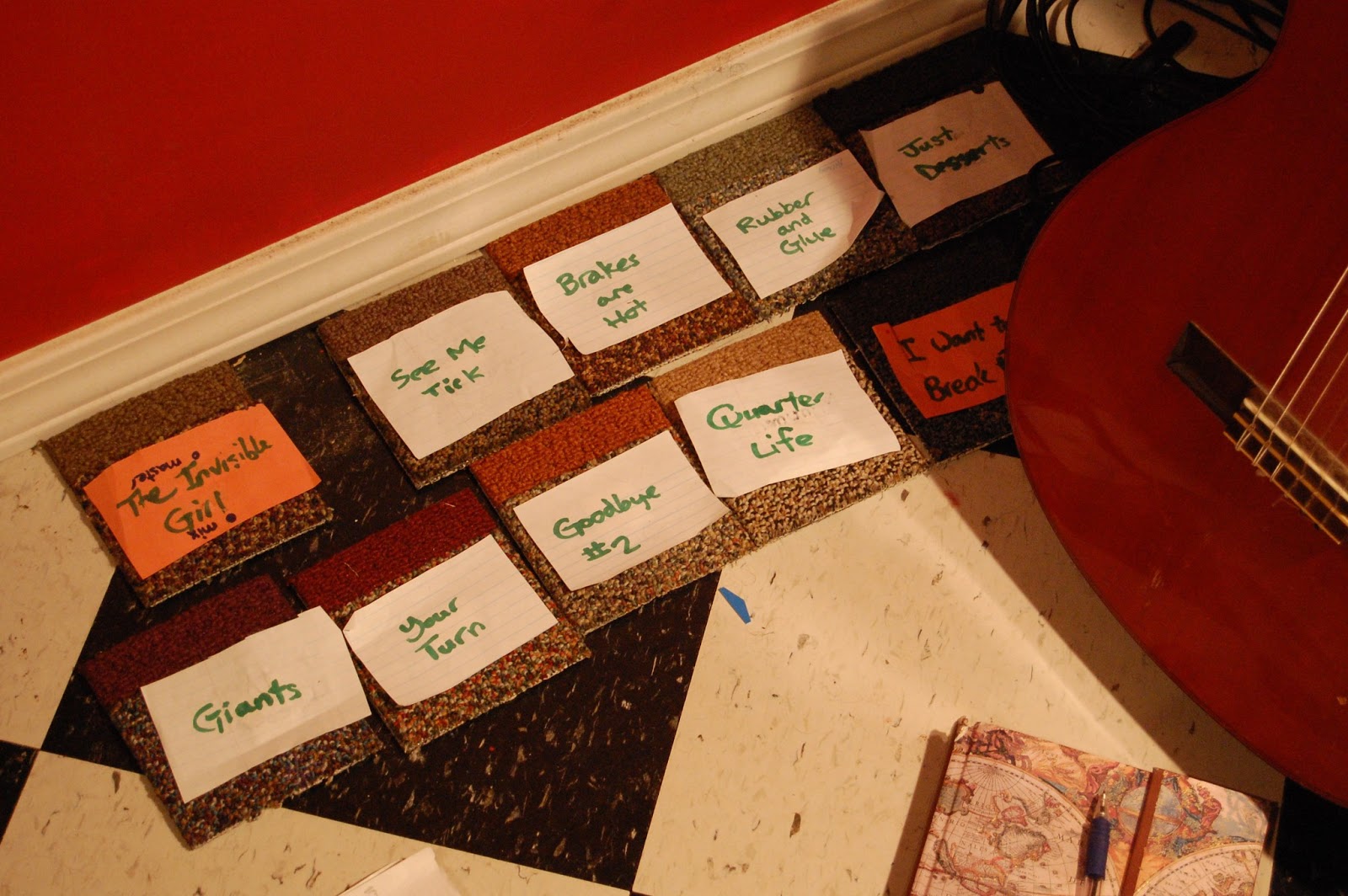
Alright, so in the end I finished twelve songs, ten of which I decided to record. Just like the last album, I put them on bits of carpet that I rearranged to work out a sequence. I wanted to start working on the sequence earlier in the process so I can prepare for the transitions better. It can always be changed later, but I wanted to have something that I think works early on. It's especially important on this album because the songs are more tightly integrated than anything I've done previously; many of them rely heavily on the same chords and certain sections "call back" previous songs. Being able to allude to previous lyrical themes simply by reusing the music is a new idea for me, and it strikes me as a pretty powerful tool for creating cohesion.


 I wrote them all on nylon string guitar, which I have never really played before. This changed what I wrote in a few ways. Playing without a pick meant that there are a lot more fingerstyle sections, the larger neck meant fewer bar chords and staying closer to the headstock, and the strumming sections were more painful and wound up blistering the side of my thumb repeatedly. I think of these heavy parts as misusing the instrument, beating the hell out of something that's usually graceful and self-possessed. So with that in mind I resolved to bash the crap out of the smallest drumset I could find, a rented Mapex Saturn bop kit with an 18" bass drum.


 I hadn't had any cymbals at all on the last album because I didn't have any I thought were worth recording but this time around I wanted a nice ride cymbal, something complex, dark and washy. I rented a Sabian Artisan Vault 22" ride, and heavily overused it on the drum parts, with almost no hi-hat.


I got the drum parts mostly how I wanted them but don't seem able to produce the kind of tightness that I want on them. Suppose I would have to practice more. Instead, I decided to do the bass recordings and then edit both tracks for tempo abnormalities until I think they sound solid, then proceed with the rest of the recordings.

I used the same 1972 Fender P-Bass running into a 1971 Traynor YBA-1 that I used on the last one, running into the high impedance input on the first channel and blending with the DI.

I built a little bass house for my microphones, the NT1a and a CAD KBM412 that I had lying around. I used this combination on the kick drum as well, with the NT1a back about a foot on the batter side. The CAD mic does a good job on the very low end but I didn't like it much until I tried blending it with the snap of the NT1a on the other side.

I figured the same approach would work for the bass track, but in my rough mixes I just find myself muting one or the other and blending with the DI. I have the bass tracks recorded and am proceeding with the  rhythmic tweaking. Then comes guitar, vocals, and other fun surprises.

Thursday, January 3, 2013

Nancy, que pasa?

Welcome to 2013. This year, I will leave my room. I will play shows. I will meet new and wonderful people. I will win at least two contests. I will write 50 songs, and complete mastered recordings of 36 of them. These are my goals.

I sold my tour van to a 72-year old hook-handed Scotsman today. On the other hand, he had two fingers and a thumb. Oh, and two replaced hips, and he can't pick it up until Friday because he's got an appointment at the cancer clinic. He made me promise never to work with asbestos. Fine by me.

I'm also writing my next batch of songs. I started with a list of song ideas, much like I did for the last album, but this time I'm working on them less linearly. I'm getting the song's message down first and writing with that as a guide, trying to stay as true to it as I can. A couple of ways I have found for dealing with a song that has me blocked: playing energetic covers and coming back to the song can psyche me into a more adventurous and productive mood. Also, writing the next idea as nakedly and unpoetically as I can seems to be very helpful. If I can read the idea I can visualize different ways to dress it up, make it fit with the rest of the song.

So I have five new ones that I'm sure I'll use, and another old one that I can re-purpose (like I did with "Wonderful Life" on the last CD). I'm about halfway there. Here's the little paragraph I wrote in my notebook about how these songs are related:
This album addresses fears I have that I can be childish and shallow in personal relationships. It's about not being emotionally mature enough to truly love. It's about intelligence being squandered by poor emotional understanding and control. It's about learning what it is to be fair and good to others without that being at the expense of oneself. Its thesis is that empathy is essential to happiness.
As a consequence of this, the protagonist in a lot of these songs is me indulging some of my more stunted and infantile desires. The best one so far is made almost entirely of playground rhymes. I like it because I think it's enjoyable at many levels of intellectual and thematic involvement, from first-listen background music to tenth-listen lyric-booklet-in-the-lap. For now when this happens it's fairly accidental, but it's something I hope I'll be able to learn to do better with time. Just look at The Hardest Way to Make an Easy Living by The Streets. I do envy the words per minute of his genre. Ah well.

Tuesday, December 11, 2012

West-Coast Stubbornness

Well, fantastic. I put the album online last Friday and a few people have heard it. Feedback from my friends has generally been good; so far no one has felt the need to tell me they didn't like it. There doesn't seem to be a clear-cut best song, as the nine people who've mentioned theirs to me have picked six different songs. Which is too bad in that I don't feel confident in heavily promoting a single from it, but good in the sense that it means I've done solid, consistent work. As I get better on future releases I can just try to up this average quality.

Speaking of which, I'm writing for the next album, which I fantasize I can be finished with by the end of February. Being able to produce an album's worth of material from scratch in three months would be a great turnaround time. That way I could do three a year, and if I can complete thirty-plus songs that I'm proud of, you'd think there'd be a dozen in there that anyone would be proud of, that would stand up to a proper commercial release (with some professional remixing).

Even if this is just an informal release, I'd like to try to promote it a bit, at least to get a sense of how good it really is and how far I still have to go. My promotional goal for this one is really just to get on a few people's musical radar who don't already know me personally. And to make some industry contacts, at least find some people I can annoy again when I'm done the next one. I also want to contact some of the artists that inspired me while making this last one, with no specific goal except that if one of them happened to like my stuff it would be gratifying. So I suppose promoting this album is about letting some people know I'm throwing my hat in the ring, and testing the strength of my material. We'll see what comes of it!

Wednesday, December 5, 2012

Traditional/Not Traditional

I have finished my first draft masters for the album, and told the (dozen or so) people that want to listen to it that it will be done by Friday. I have yet to really test the songs on other sound systems, but listening to them on headphones is quite gratifying. I've never spent any time learning the mastering process so the last couple days have been great for me. I don't usually think of mastering as a dramatic process but I think I've dramatically improved on the sound of the mixes; this was the missing link in my record-making chain.

One neat thing I've done is used EQ matching to try and reshape the overall tonal balance of my songs to a professionally recorded one. I grabbed four songs from the sample CDs I'd uploaded previously and tried matching the lead album track EQ to them. They were "The Suburbs" by Arcade Fire, "Nowhere Lullaby" by Built to Spill, "Losing My Religion" by REM, and "Black Day in December" by Said the Whale.

The Built to Spill track is quieter on the high end, and applied to my mix it sounded a bit dull and muffled. "Losing My Religion", with the bright string instruments, had the opposite problem. The Arcade Fire track had more low bass than the other reference tracks, which didn't make an audible difference to my mix, but it also had a weird curve in the high frequencies. Instead of following the 6 dB per octave curve (like the other three do, at different levels) they start to roll off around 10kHz and continue downward parabolically. When applied to my mix I found it made the mids sound a bit boomy. I found that the Said the Whale track to be clear and bright, but not overly so. I loved how my mixes sounded when matched to this EQ, especially with a bit of tape saturation applied as well. 

So I tried it across the whole album. Since the instrumentation varies considerably, this meant a lot of tweaking, but right now I have an album that sounds much more coherent than anything I've done before. I'll try it on some other systems and probably have to work on the bass, but for now I'm excited.

Monday, December 3, 2012

35 People are Here


I got the mixes to where I thought they were solid on my own, but today I let my immediate family listen to them. It was also the first time I've heard the mixes on a commercial-grade stereo, which was very helpful. Mixing as I do on tiny 3" monitors or Sony MDR-7509HD headphones, judging the bass level and evenness is tough. Fortunately the bass sounded fine on a few of the songs, so I'm hoping I can just replicate those settings on the problematic ones. More a/b testing is required.

On first listen they didn't have many specific concerns about the mixes or the track sequencing, except to redo one vocal line and turn the trombone down, so I think I'm doing okay. I'm getting better at setting the vocal level but melody instruments are still tough for me (check how loud the violin is on this EP I mixed); I think it's that I hate to bury a part I've worked hard on. But as I tweak the mixes I find I'm thinking about them less as "band" recordings and more as voice and guitar recordings that happen to have other instruments to fill out the sound. Because I don't have a band, and when I perform these things I'll likely be doing them solo, so the mixes should be set up so that listeners can at least conceive of them that way.

I haven't actually given much thought to adapting them for performance yet. Instead I'm conceptualizing material for my next album, which may even be another notch softer than this one, and this one's already pretty AAA-friendly. I'd like to try recording the next one very simply, without a click, and with minimal instrumentation. I've learned all kinds of things on this last project all ready and I'm sure when I put it out I'll get all kinds of useful feedback as well. So the next one can only be better!